The conversation around AI has moved past the "what if" phase. Much of the American workforce is now using AI at work, and adoption is steadily growing. However, access has not yet translated into transformation. This gap reveals a critical challenge: employers want AI-skilled talent, and workers want to reap the benefits of this advanced technology, but neither fully understand how to deploy it for measurable returns.
The promise is clear for businesses and workers—AI can process information, draft professional communications, and manage workflows with unprecedented speed. But realizing these capabilities and delivering ROI for employees and employers requires more than tool access. It demands a specific set of competencies that allow workers to offload repetitive tasks and reallocate their effort toward high-value work. For many teams, however, the arrival of AI has exposed a significant learning curve rather than sparking immediate productivity gains.
Without a shared understanding of the specific AI skills that matter, and the contexts in which they deliver value, organizations cannot build or deploy effective training programs. Currently, many employers are caught between two unproductive extremes: scattershot upskilling, where training is reactive and lacks strategic coherence, or hyper-narrow pilots that work for a few specialists but never reach the rest of the company. This leaves large segments of the workforce without relevant, robust training.
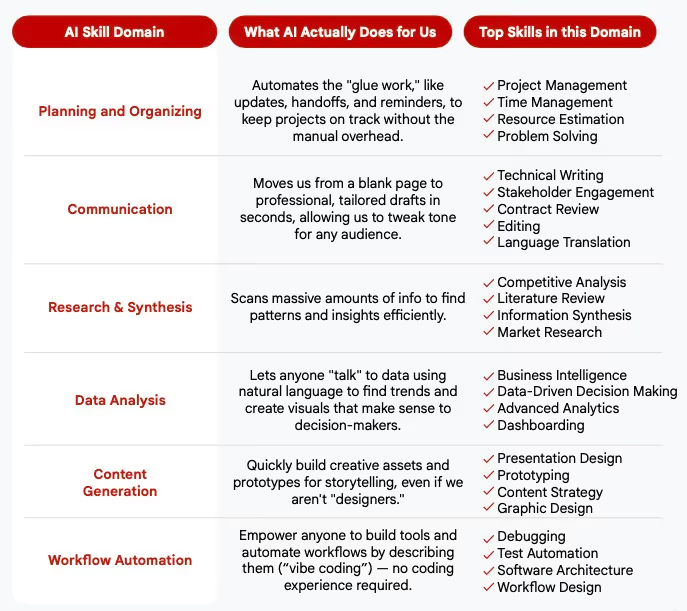
To help address this gap, the Skills-First Workforce Initiative, in partnership with The Burning Glass Institute and Grow with Google, developed a framework for AI upskilling in the workforce. This framework combines a clear definition of “AI Acumen” with a map of the six key “AI Skill Domains” where AI is rapidly transforming work. We started by cataloguing over 700+ generative AI capabilities, such as data analysis, content creation, and workflow automation, and then mapped these capabilities to 450 of the most prevalent “knowledge worker” skills, such as technical writing and project management. These skills were then clustered into six core AI skill domains where AI is transforming work:
Planning & Organizing
Communication
Research & Synthesis
Data Analysis
Content Generation
Workflow Automation
But beyond defining where AI is transforming work, SFWI companies determined it was equally important to define what workers need to learn to be able to leverage AI tools. This led to a consensus-driven definition of “AI Acumen”, centered on three key themes:
Fundamental knowledge: Understanding where AI creates value and identifying tasks where it does not.
Application and effective use: Mastering the mechanics of interaction, including prompting with clear context and constraints, fine-tuning model behavior, and selecting the appropriate model for a specific task.
Responsible use: Ensuring human oversight and responsibility for outputs and discerning where genAI tools should not be used, such as with confidential data or situations requiring high-stakes judgment or empathy.
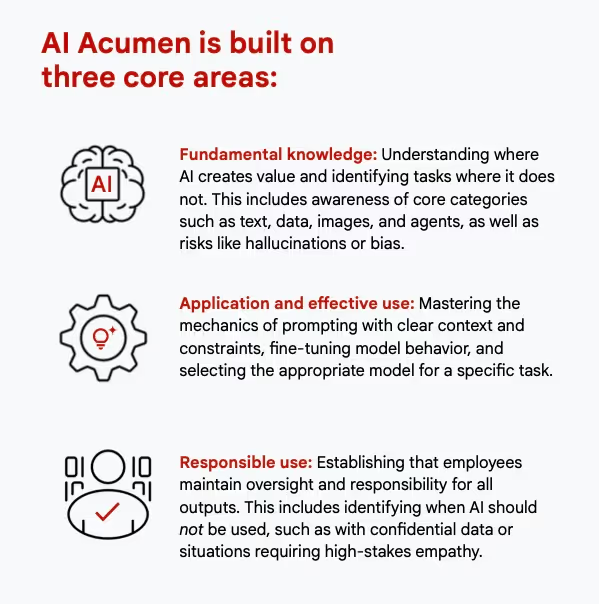
Together, this definition of AI Acumen and the AI Skill Domains provide the foundational basis for companies to plan and invest in AI upskilling across functions, rather than in role-based silos. This research-backed, employer validated framework paves a path for upskilling the workforce and enabling organizations to integrate AI with a coordinated, people-centered approach.
Read the full report below to learn more.